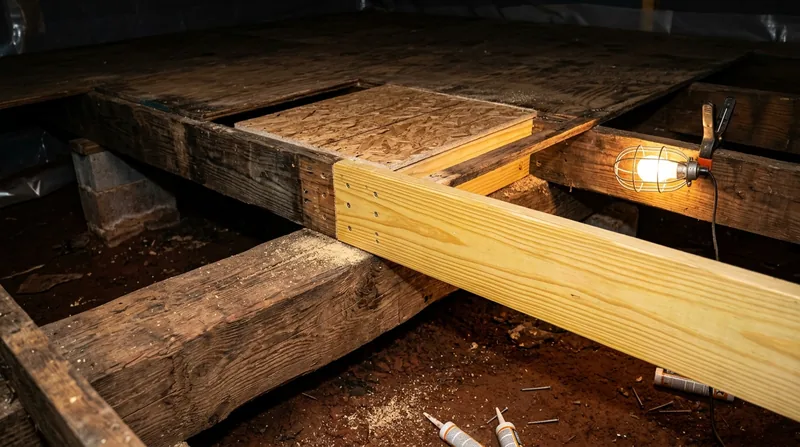




Sagging, bouncy, or uneven floors in Charlotte's older homes often signal floor joist and subfloor repair work ahead. The problem usually traces to moisture damage in the joists or subfloor itself, made worse by the Piedmont's dense red clay that wicks moisture up through foundations and around rim joists year-round. Colonial Revival estates in Myers Park, Craftsman cottages in Dilworth, brick bungalows in Elizabeth, and the ranch and split-level homes that fill Cotswold and Sedgefield all sit on the same gently rolling terrain where standing water and poor drainage create the damp conditions that weaken wood. We sister compromised joists, replace damaged subfloor sections, and rebuild support where floors have settled or moved, bringing them back to level and solid. The work is straightforward carpentry, and the sooner it's done, the less secondary damage spreads to rim joists, sill plates, and the framing above.
Why Floor Joist and Subfloor Damage Matters in Charlotte's Humid Climate
Charlotte's subtropical Piedmont climate brings hot, humid summers and occasional heavy rain that can saturate the ground around a home's foundation for weeks. The iron-rich red clay that dominates the landscape drains poorly, and moisture wicks upward through the soil and into wood framing that sits close to grade. Over time, this persistent dampness softens wood fiber, reduces the joist's ability to span and carry load, and can eventually let a floor sag noticeably. A bouncy or soft floor is not just uncomfortable to walk on, it signals that the joists underneath are losing structural capacity. Left unaddressed, sagging floors can crack drywall, stress door frames, and make interior doors bind or swing on their own.
- We inspect joists and subfloor for soft spots, rot, and compression damage using hands-on testing and, where needed, moisture readings to confirm the extent of the problem.
- We sister new lumber alongside compromised joists using bolted connections to restore full load-bearing capacity without removing the damaged wood in every case.
- We replace subfloor sections where rot or compression is too far advanced, using pressure-treated lumber or solid hardwood depending on the floor above and the building code in effect.
- We address the moisture source by improving drainage, grading, or ventilation so the repair stays dry and the problem does not return.
Stopping floor movement early prevents compounding damage to the structure above and keeps your home level and safe to live in.
Key info: Charlotte's older homes often sit on brick piers or shallow foundations where rim joists and sill plates absorb moisture from the surrounding soil. In neighborhoods like NoDa, Dilworth, and the Elizabeth area, converted mill cottages and Victorian-era homes with century-old framing are especially prone to this kind of slow, moisture-driven joist decay. A free inspection will show you whether sistering, replacement, or improved ventilation is the right fix.
For more on moisture-related wood damage, see our wood rot and dry rot repair page, which covers similar pathologies in other parts of the home.
How We Repair Floor Joists and Subfloor in Charlotte Homes
Our repair process starts with a clear diagnosis. We measure floor slope using a level, probe suspect joists with a screwdriver or moisture meter, and identify whether the damage is localized or spans multiple joists. Once we understand the scope, we choose the most cost-effective repair: sistering is often the right call for joists that are still structurally sound but weakened; full replacement makes sense when rot or compression has gone too far. We work from below whenever possible, minimizing disruption to the floors and finishes above, and we build temporary support so the floor stays level and safe during the work.
- We inspect the joist and subfloor, checking for soft wood, rot, insect damage, and moisture sources using hands-on testing and visual examination.
- We install temporary support posts and beams if needed to carry the load while we work, preventing further sagging or movement.
- For sistering, we cut and bolt new lumber alongside the damaged joist using lag bolts spaced 16 inches apart, creating a composite beam that restores full capacity.
- For replacement, we remove the damaged joist, cut and install new pressure-treated or solid lumber to match the original span and depth, and bolt it to the rim joist and beam below.
- We replace compromised subfloor by removing rotted sections, inspecting the joists beneath, and installing new pressure-treated plywood or hardwood subflooring, fastened to the joists with corrosion-resistant nails or screws.
- We remove temporary support and verify that the floor is level, solid, and moves no more than 1/8 inch under foot traffic before we finish.
The work typically takes one to three days depending on the number of joists involved and the size of the subfloor section to be replaced.
Example: A Myers Park home built in 1925 had three joists under the dining room that had softened from decades of moisture wicking up from the crawl space below. Rather than replace all three joists, we sistered new 2x10 Douglas fir alongside each one, bolted them securely, and improved the crawl space ventilation. The floor came back level, the repair cost less than replacement, and the original joists remain in place as part of the home's structure. The work took two days, and the homeowner was back to normal within a week.
Learn more about our broader framing and structural carpentry services for load-bearing repairs and other structural work.
Repair Methods and When to Use Them
| Approach | Description | Best for |
|---|---|---|
| Sistering | New lumber bolted alongside the damaged joist to restore capacity and spread the load across both members. | Joists with surface rot, compression, or moisture damage that still have core strength and are not severely compromised. |
| Full Joist Replacement | Damaged joist removed entirely and replaced with new pressure-treated or solid lumber of matching dimension and grade. | Joists with extensive rot, severe compression, or structural failure that cannot safely carry load even with a sister. |
| Subfloor Patch | Localized subfloor section removed and replaced with pressure-treated plywood or hardwood, fastened to sound joists. | Rot or water damage confined to one or two subfloor bays, with joists beneath still sound and able to support new material. |
| Moisture Control and Ventilation | Crawl space vents opened or added, grading improved around the foundation, or drainage installed to keep joists and subfloor dry long-term. | Any joist or subfloor repair, to prevent moisture from returning and causing the same damage again in five to ten years. |
Floor Joist and Subfloor Repair Cost in Charlotte: What to Expect
A straightforward floor joist and subfloor repair in Charlotte typically starts at around $1,800 for a single joist sistered or a small subfloor section replaced. The actual cost depends on several factors: how many joists need work, whether you are sistering or replacing, how large the subfloor area is, how easy access is from the crawl space or basement, and whether the joists are standard dimension (2x8, 2x10) or require custom sizing. A home with two or three joists to sister and a small subfloor patch might run $2,500 to $4,500. Larger jobs involving five or more joists, multiple subfloor sections, or difficult access can easily exceed $6,000. Addressing moisture sources, such as improving crawl space ventilation or grading, may add $500 to $1,500 depending on the scope.
The best approach is to get a free, no-obligation estimate from us. We will inspect the damage, explain what needs to be done and why, and give you a firm price before we start work. Many homeowners find it helpful to get two or three estimates so they can compare approaches and pricing. Keep in mind that the cheapest estimate is not always the best, especially if it avoids addressing the moisture problem or proposes replacing joists that could be successfully sistered and preserved.
See our full pricing page for more detail on what drives costs up or down, and call us at (980) 324-3978 for your free estimate.
Floor Joist and Subfloor Repair Near Me: What to Look for When Hiring a Carpentry Contractor in Charlotte
When you are ready to hire a contractor for joist or subfloor work, a few key details will help you choose the right fit. First, confirm that the contractor is fully insured and willing to provide proof of general liability and workers' compensation coverage. Second, ask for references from recent jobs in your neighborhood or similar homes, and actually call them to ask about the quality of work and whether the contractor showed up on time and cleaned up after. Third, get the estimate in writing so you know exactly what is included, what materials will be used, and what the total price is before the work begins. Fourth, if the repair involves altering or removing any structural framing, confirm that the contractor understands whether a permit is required and will pull it through the Charlotte Building Inspections Department. Fifth, if your home is in a historic district or subject to HOA design review, check whether the repair work needs approval before it starts.
A good contractor will explain the problem in plain language, show you the damage, tell you why they are recommending a particular repair method, and answer your questions without pressure or urgency. They will also be able to discuss moisture sources and how to prevent the problem from coming back. If something does not feel right or the contractor seems to be pushing replacement when sistering would work, get another opinion.
Ready to move forward? Contact us for a free estimate, or call (980) 324-3978 to discuss your floor.
Floor Joist & Subfloor Repair in Charlotte: Pricing Guide
| Service | Price | Details |
|---|---|---|
| Single joist sistering | Starting at $1,800 | Includes new lumber, bolts, and labor to restore one joist to full capacity without removal |
| Multiple joists or subfloor patch | Starting at $2,800 | Two to three joists sistered or one subfloor section replaced, plus moisture assessment and grading advice |
| Full subfloor replacement or complex repair | On estimate | Scope involving five or more joists, large subfloor areas, or difficult access requires on-site inspection for accurate pricing |
| Moisture control and ventilation upgrade | Starting at $600 | Crawl space vents, grading work, or drainage improvements to prevent future moisture damage and extend repair life |
| Free estimate and consultation | No charge | We inspect the damage, explain the repair options, and provide a firm price with no obligation to book |
Indicative pricing, the exact cost depends on square footage, finish, and site access. Free personalized estimate within 24h at (980) 324-3978.


